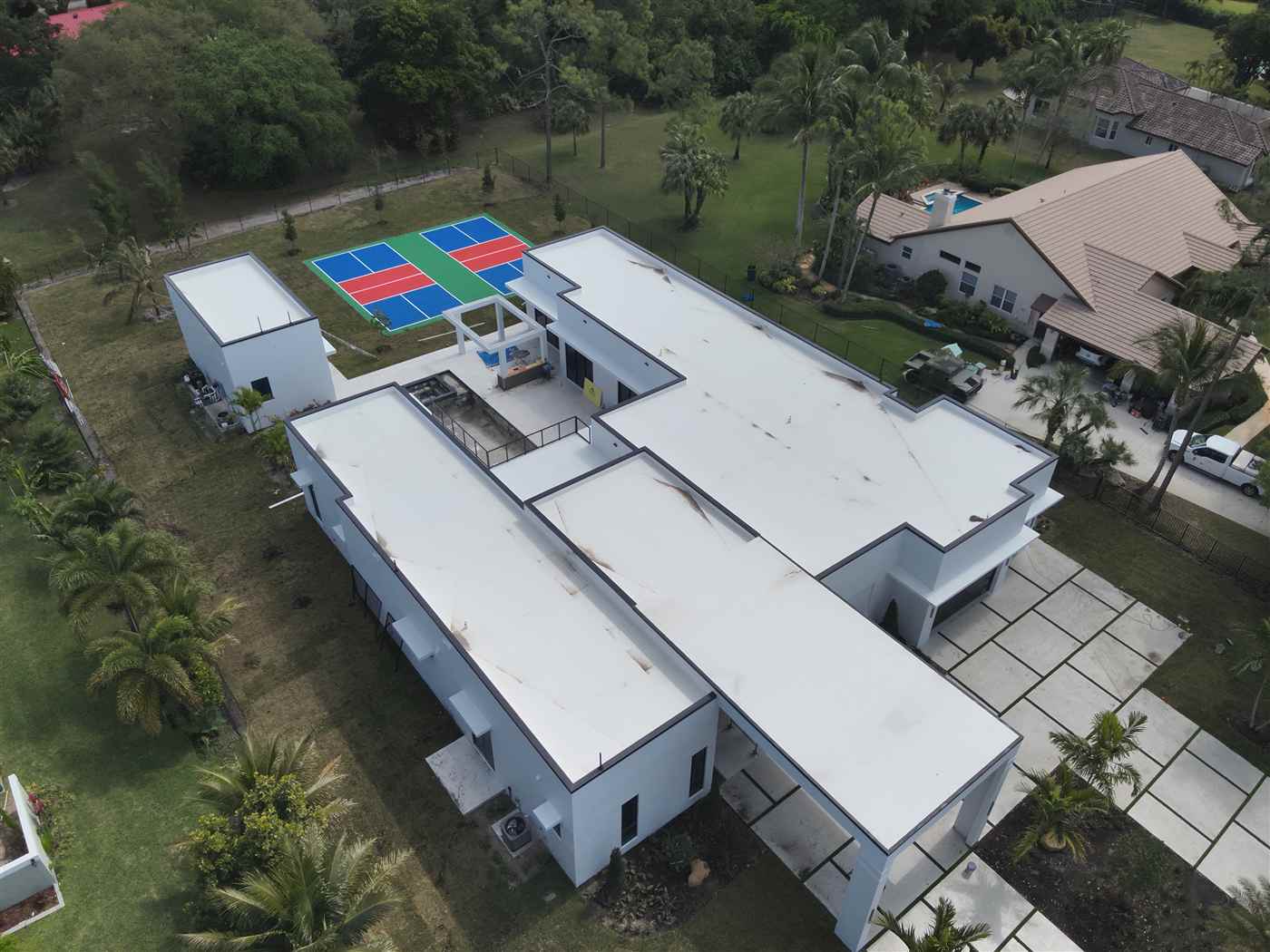
A commercial roof rarely fails overnight. Flat and low-slope roof systems usually deteriorate quietly over months or years, driven by standing water, failed seams, unsealed penetrations, and deferred maintenance, until a storm or a leak forces an emergency repair or replacement.
Unlike steep-slope residential roofs that shed water naturally, commercial flat roofs rely on membrane systems, drainage, and precise flashing around rooftop equipment.
This guide covers the most common causes of commercial roof failure across TPO, EPDM, and metal systems, plus practical steps facility managers in Florida, Pennsylvania, and New Jersey can take to protect the roof they have.
What Makes Commercial Flat Roofs Vulnerable?
Residential roofs have steep pitches that let gravity carry rain to the gutters. Commercial roofs cover broad areas with low slopes, so water has to be actively channeled to scuppers, interior drains, or gutters.
Commercial roofs also work as utility decks. They host HVAC units, exhaust fans, conduit, and other equipment that needs regular servicing, and every rooftop unit adds curbs, penetrations, and details that have to stay watertight.
Eight Common Causes of Premature Commercial Roof Failure
1. Ponding Water and Poor Drainage
Water that lingers on a flat roof long after rainfall is called ponding water. It usually comes from inadequate slope, clogged drains or scuppers, deflected decking, or insulation installed without the right slope.
Standing water adds weight, speeds up membrane wear, and concentrates stress at seams. Good design builds drainage in: in Florida’s heavy rain, tapered insulation creates slope so water leaves the roof rather than pooling in low spots.
2. Open Seams
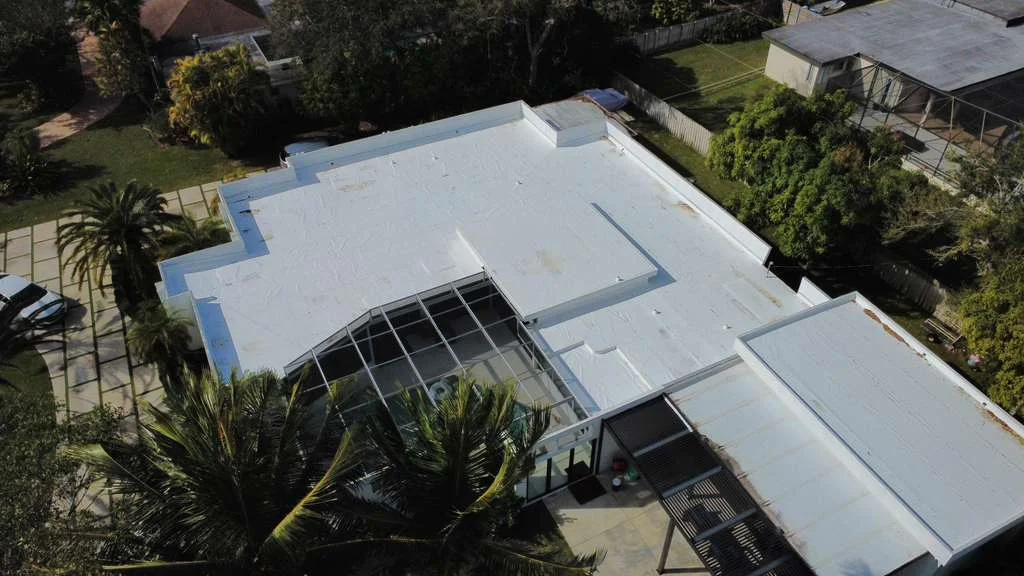
On single-ply roofs, seams are a primary line of defense:
- TPO membranes: Seams are generally heat-welded. Poor welding or a contaminated surface can leave a weak weld that opens under thermal movement.
- EPDM membranes: Seams are generally adhered or taped. Constant thermal movement and ponding water can break down the bond over time.
Once a seam opens, water can travel under the membrane and saturate insulation far from the original entry point.
3. Flashing and Penetration Failures
Flashing seals the places where the roof meets parapet walls, expansion joints, skylights, and HVAC curbs. Because flashing joins different materials, differential movement puts it under constant stress.
The Insurance Institute for Business & Home Safety (IBHS) low-slope metal roof guide notes that installation errors such as loose fasteners and improper spacing compromise performance, and that penetrations through seams call for customized curbs to stay weathertight. See the IBHS guide to low-slope metal roofs for more on how detailing drives results.
4. Foot Traffic and Mechanical Punctures
HVAC technicians, plumbers, solar installers, and other trades walk commercial roofs. Dropped tools, sharp equipment feet, and heavy boots can puncture TPO or EPDM membranes. Without designated walkway pads, small punctures can go unnoticed until stains appear on interior ceiling tiles.
5. Flawed Installation and Workmanship Shortcuts
Even a good membrane can fail if it’s installed poorly. Common installation problems include:
- Inadequate surface preparation before adhesives or welding
- Incorrect fastening or spacing
- Poorly detailed edges and terminations
- Overlooking local code requirements for wind uplift
A sound installation starts with a deck and drainage assessment, correct insulation and slope, careful detailing at curbs and drains, and the permits and inspections the project requires. Our commercial flat roofing approach covers those steps.
6. Deferred Maintenance
Putting off minor repairs is one of the quickest ways to shorten a roof’s life. A small seam separation, clogged drain, or cracked sealant is inexpensive to fix during a routine inspection. Left alone, the same flaw can saturate a large area of insulation and turn a small repair into a major one. Our guide to flat roof maintenance best practices covers what regular upkeep looks like.
7. UV Exposure, Heat, and Thermal Cycling
Sun, heat, and weather wear on roofing surfaces over time:
- UV and heat (Florida): Membranes can chalk, harden, and lose flexibility.
- Freeze-thaw cycles (Pennsylvania and New Jersey): Water that gets into small gaps can freeze and expand, stressing seams and flashings.
8. Wind Uplift and Storm Damage
Wind pressure is not uniform across a roof. IBHS’s guide on roofing codes and standards explains that design pressures vary by roof zone, with perimeters and corners seeing higher pressures than the field of the roof, and that requirements should be verified with the authority having jurisdiction. High winds can lift loose perimeter flashing and edge details, which can allow a peel-back failure. For Florida properties, wind and product-approval requirements differ between statewide rules and the High-Velocity Hurricane Zone in Miami-Dade and Broward.
Failure Causes by System
| Cause | TPO | EPDM | Metal |
|---|---|---|---|
| Ponding water | Stress at seams and surface | Stress at seams and membrane | Less common on sloped metal but can affect low-slope panels |
| Seam or lap failure | Welded seams can open | Adhered or taped seams can open | Laps, sealants, and fasteners can loosen |
| Punctures and traffic | Can puncture | Can puncture | Dents and coating damage |
| Flashing and penetrations | Frequent leak source | Frequent leak source | Penetration seals and fasteners |
| UV and aging | Surface aging | Surface aging | Finish and sealant aging |
This is a general guide. The failure modes of a specific roof depend on its installation and condition.
The Hidden Problem: Wet Insulation
When water gets through the membrane, it can collect in the insulation below. Wet insulation matters because:
- It loses performance: Wet insulation loses much of its thermal effectiveness.
- It can damage the deck: Trapped moisture can rot wood decking and corrode steel decking from above.
- It limits restoration: Coatings should not be applied over wet insulation. Damaged sections generally must be cut out and replaced.
How Scheduled Maintenance Protects the Roof
There is no single inspection interval that fits every commercial roof. Roof age, material, climate, storm exposure, rooftop equipment, and warranty terms all matter. A scheduled maintenance program with documented inspections, plus an inspection after severe weather, is a sound approach. A structured program typically includes:
- Clearing debris from drains, scuppers, and gutters
- Inspecting seams and laps
- Checking penetration seals, pitch pockets, and expansion joints
- Monitoring curb flashing and walkway pad condition
- Documenting roof condition with photos
To see how this works in practice, learn more about our commercial roof maintenance service.
Repair, Restore, or Replace?
- Routine maintenance: Right when the system is sound, the insulation is dry, and issues are limited to surface wear or flashing touch-ups.
- Restoration coating: A possible option when the insulation is dry and the membrane is still well bonded and sound. A reflective coating can extend a suitable roof’s useful life, but it is not appropriate over wet insulation or failed membrane.
- Full replacement: Often the practical choice when wet insulation is widespread, the deck is compromised, or repeated leaks show the system is failing.
Frequently Asked Questions
What is the most common cause of commercial flat roof leaks?
There is no single cause, but poorly sealed penetrations, open seams, and flashing failures are common entry points, and ponding water from clogged or poorly sloped drains tends to speed up those failures.
How long should a commercial flat roof last?
There is no guaranteed lifespan. Service life depends on the material, design, installation quality, climate, and maintenance, which is why documented inspections and preventive maintenance matter.
Can you spray a coating over a leaking commercial roof?
Only if the insulation underneath is dry and the roof is a suitable substrate. Coating over wet insulation can trap moisture and allow damage to continue, so a moisture assessment should come before any restoration coating.
How do I know if my flat roof insulation is wet?
A professional can use non-destructive tools, such as infrared imaging and moisture meters, to help map moisture beneath the membrane, sometimes combined with core samples, without cutting open large areas of the roof.
Get a Commercial Roof Assessment
Don’t wait for interior leaks to interrupt your operations. Maze Roofing provides photo-documented commercial roof inspections across South Florida, Tampa Bay, Southwest Florida, Greater Philadelphia, and South Jersey. Request your commercial roof assessment to get a clear picture of your roof’s condition.